
On subscription-based websites, digital publishers often restrict the majority of content to registered users and/or paid subscribers. However, publishers still need a way to enable non-registered users to sample the website in order for the visitors to more fully understand the benefits to subscribing. This is sometimes called a "softer" or "combination" paywall as opposed to a fully hard paywall (everything protected) or a "porous" paywall (everything available given the right conditions).
One solution for a softer / combination paywall that Mugo recently implemented uses special "hash" URLs to provide time-limited, full access to select articles.
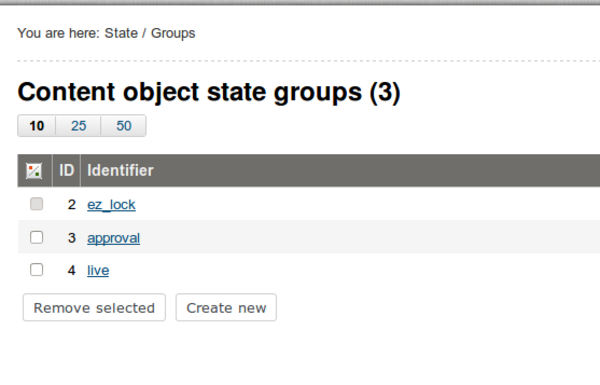
Object states are used in many ways in eZ Publish, from workflows to menu management to controlling SEO tags. In eZ Publish 5, object state information is not available by default as one of the intrinsic attributes of a content or location object. In this post, we will show you how to access object states in PHP (usually in your custom controllers) or in Twig templates.
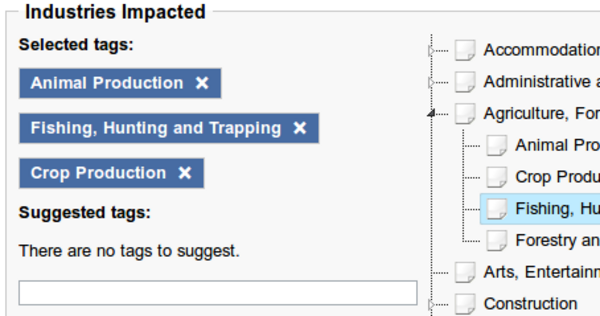
The eZ Tags extension by Netgen is a great solution to the problems of managing large or ad hoc taxonomies. It especially solves problems around editorial user experience.
Recently, Mugo has added a bunch of improvements to the extension. This post talks about 2: allowing users to reorder tags by assigning priorities, and to select tags from a tree menu.

If you have a membership-based website, the standard model is to provide users access via a username and password. Enterprise customers often require more advanced validation models. Here, we sketch out use cases around validating by IP address or referring URL; and as a bonus topic: multi-seat accounts. We've implemented these advanced features for a couple of sites and they work seamlessly.

eZ Publish is a powerful Content Management System (CMS), but you typically don't try to build Customer Relationship Management (CRM) and E-mail Marketing features directly into it. Instead, you usually integrate it with existing solutions. We recently integrated eZ Publish with Salesforce and Marketo on a subscription-based website.

Mugo's eZ Collaboration Workflow extension has been released for a few years now. We've been able to make continuous improvements over time to solve different and more complex client needs. Here's an update on some of the recent new functionality around multi-language workflows, editing other users' drafts, and scheduled publishing.

In eZ Publish 4 / legacy, formatting link URLs is handled by the well-known ezurl() template operator. This is especially useful when you have multiple siteaccesses and you use URL-based matching. In eZ Publish 5, there is no single ezurl() equivalent; instead, there are several options depending on the type of link you want to display.

Varnish is great for high traffic sites where the same pages are served over and over to millions of visitors, but when you have to do something differently depending on the specific user or user group, things get complicated. There are several techniques, and how you might use them depends on the details. Here, we have outlined a solution for a particular use case on eZ Publish.

Index time plugins are one of the most important techniques of extending eZ Find functionality; they allow you to control how and what data is indexed. Combined with custom eZ Find queries, this opens up huge opportunities for providing access to content, well beyond mere 'search'.
In this post we will look at some typical use cases, briefly consider out of the box functionality and then dive into why you would want to make use of index time plugins and how you would go about setting one up.
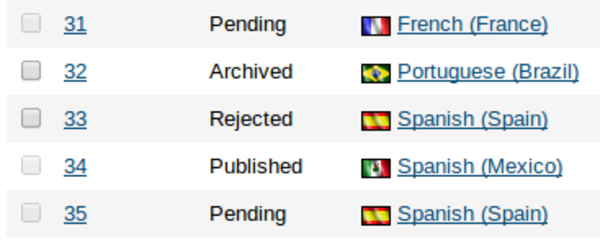
Whenever you edit content in the eZ Publish Administration Interface, eZ Publish stores a new version. eZ Publish has a built-in feature to limit the number of previous versions it stores. However, as of the time of this posting, the eZ Publish 5.x public API to create and update content does not respect the version history limit (which, by default, stores 10 previous versions). We've written a quick function that restores this feature.
In the following article we are going to show you how to fetch information in the new eZ Publish version considering that permissions may be set in place on different sections and we will compare it to how is it done in the legacy kernel.
During the flow of this article we will introduce a new undocumented method which is going to let us bypass permissions set to different sections.
Using virtual machines when developing eZ Publish websites have been useful in 2 main ways (if not more): working in a different server environment than your current machine and standardizing the dev environment for a team of developers. At the moment, I have Ubuntu 13.10 installed as my main operating system, and from time to time I need to work with some older eZ Publish versions that require PHP versions older than Ubuntu 13.10's default; in fact, the oldest eZ Publish version that I can run out of the box on Ubuntu 13.10 is eZ Publish 4.7. I don't like the idea of installing another OS just to work with an older eZ Publish version; that requires creating another partition, configuring grub, and so on. Using virtual machines enables me to work within another OS inside my main OS. That way I can work on a standardized environment specific to each client, while continuing to use my favorite base OS and tools. In this tutorial, I will describe how to install and configure Oracle VirtualBox to create virtual machines that run eZ Publish.
Mugo Web
Unit 205, 332 Columbia Street
New Westminster, BC
V3L 1A6, Canada
Phone: 604-637-6396
E-mail: hi@mugo.ca