Mugo partner since 2010
This Business Intelligence website features a paywall, caching of content for logged in users, a responsive design, enterprise login features, Salesforce and Marketo integrations, and more.
Monitor Global Outlook helps clients better anticipate new opportunities, manage risk and prevent loss in Emerging and Frontier Markets. It is the Business Intelligence unit of The Christian Science Monitor.
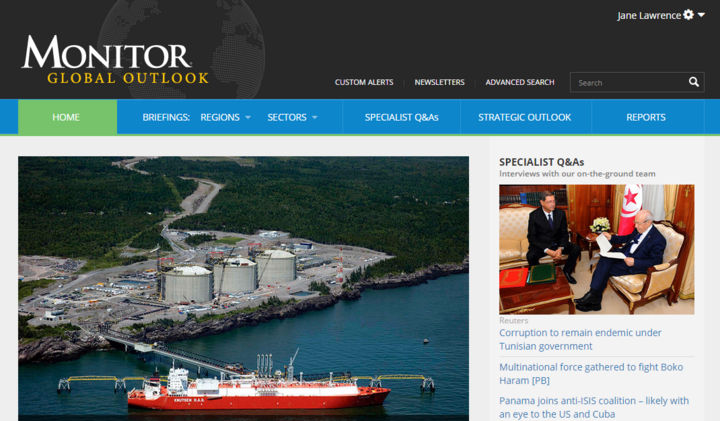
Subscribers to Monitor Global Outlook get access to in-depth reporting from 18 local offices throughout the developing world's fastest-growing regions. Mugo Web built features for personalization, multi-device support, editorial tools, and more. The site is built on top of the eZ Publish content management system.
Mugo started working with Monitor Global Outlook after we outgrew our first website and content management system. With a combination of solid tech development skills and excellent communication, the Mugo team rescued us from frequent website outages to put us on a stable foundation for growth.
We then worked together to implement a redesign, meeting fast-turnaround deadlines. I particularly appreciate their ability to propose creative, realistic solutions to our challenges and their eagerness to talk through ways to optimize the product development process.
Their team is truly part of the MGO team at this point.
- Ben Arnoldy, Product Manager, Monitor Global Outlook
Logged in users can browse site content by region and sector. Content is featured as Briefings, Specialist Q&As, and Strategic Outlooks.
There is also a rich set of search filters. Searches can be saved and shared. Searches can also be marked for alerts -- when new content is posted that matches the search criteria, the system will send out an e-mail alert.
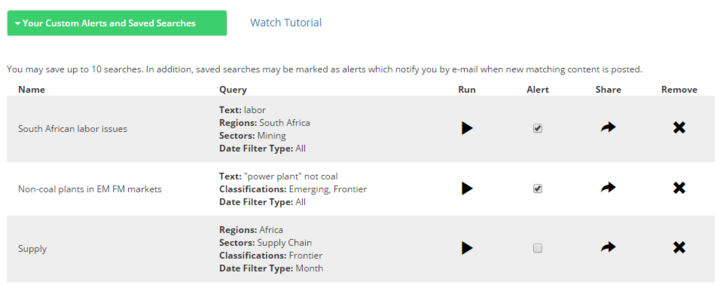
A select number of articles are freely viewable. The rest are behind a subscription paywall. For marketing purposes, Monitor Global Outlook staff can generate time-limited URLs to share full articles with prospective customers.
Monitor Global Outlook staff can also create trial user accounts so that prospective users can get a good idea of all of the site benefits. All of the site features can be customized so that, for example, a staff member can create personalized content update e-mails tailored to a trial user's interests. Trial accounts automatically expire according to a configurable amount of time or a specific date, and the system automatically sends reminder and expiry e-mails at the appropriate times.
Enterprise customers have access to enhanced login features. They can create and manage sub-accounts under a single account; configure logins by IP address ranges; and configure logins by referring URLs.
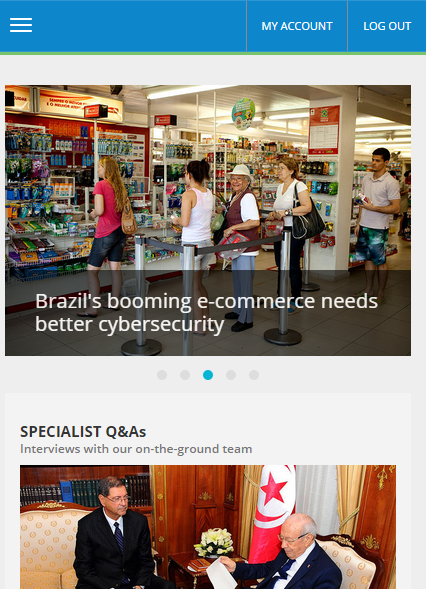
The website has a responsive design, enabling users to view the site on any device.
To support sales and marketing efforts, the Monitor Global Outlook website is integrated with both Salesforce and Marketo. Using Salesforce, lead statuses are tracked and customer information is synced between the website and Salesforce. The integration with Marketo includes the management of various subscriptions and a custom feed manager for populating newsletters.
Using Google Analytics, Monitor Global Outlook can track individual user behavior in order to better optimize the site experience.
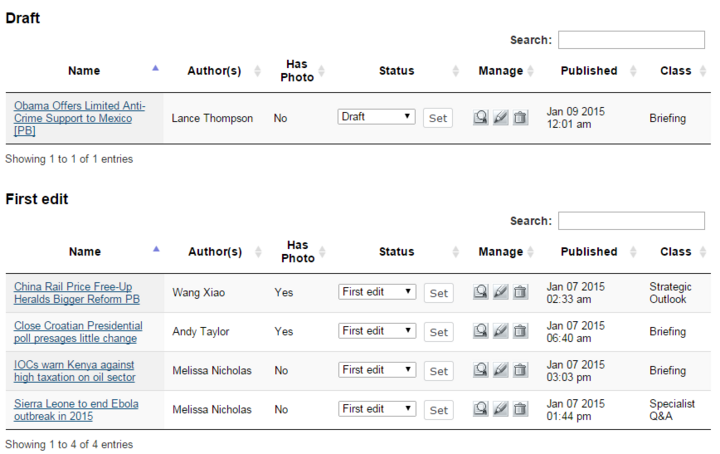
Articles go through a custom editorial workflow. This enables authors, editors, and media editors to work together at different times and different locations to prepare articles to be published.
To support the front-end user features, editors manage a powerful taxonomy tree for regions, sectors, companies, and classifications.
Editors have full control over landing pages, and can either pick specific articles to be featured in sliders and other page blocks, or configure the blocks to automatically update based on the new content by tag.
We create different variations of pages within Varnish's cache in order to deliver a high performing, dynamic site.
Content for the Monitor Global Outlook website was originally managed in WordPress. Mugo re-used its existing data import tools to create an automated migration of content from WordPress to eZ Publish. During the migration period, we set up a login bridge between eZ Publish and WordPress so that user credentials could be validated against the WordPress database.

In Canada and the US, the vast majority of provinces, states, and territories observe daylight savings time. We are scheduled to change our clocks on Sunday, November 1, 2026, falling back by 1 hour at 2:00am.
However, on March 2 of this year, the province of British Columbia decided not to observe any more time changes starting on November 1, staying on permanent daylight savings time. On June 18, Alberta made the same decision. And most recently, on September 17th, Manitoba decided to follow this precedent and will likewise stay on daylight savings permanently, starting this November.
This created some work for content editors and website developers in those provinces, and what should have been a simple update ended up requiring some investigation. Here's the story of why event calendars started to display the wrong time for events, and how we fixed it.

This year, two Canadian provinces, BC and Alberta, moved to make Daylight Saving Time permanent. This created an issue with event registrations for some of our library clients, an interesting technical solution, and the potential for future implications down the road as other provinces (and the US) potentially join the trend. This and more in August’s Mugo Digest!

Our library client wanted to allow patrons to apply for library cards via their website. The client had existing restrictions on access to cards. Local residents receive free cards while visitors and non-residents pay a fee. Individual patrons should not have access to more than one library card. Therefore the system had to automatically validate and standardize addresses to support duplicate detection, determine a geographical position for each address, and finally classify addresses as local or non-local. We supported this using GeoJSON and integrating with the library's ILS. We tested this functionality a number of ways, including an exploration into the mathematic principles behind the solution.
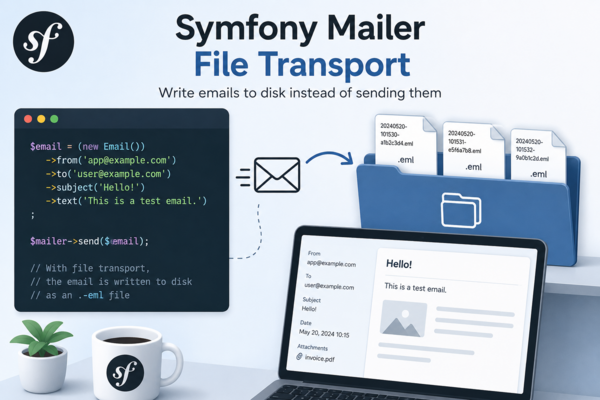
When developing a Symfony application, you often need to inspect the emails your application generates without actually sending them. While tools like Mailpit or Mailtrap are excellent choices, sometimes you want something even simpler: write every email to disk as a standard .eml file.
This approach is particularly useful for:
In this article, we'll build a custom Symfony Mailer transport that stores every outgoing email as an RFC 822 compatible .eml file.

When creating content in Ibexa using the RichText Editor, it is easy to realize that not every RichText field needs the same toolbar. A ”Body” field may need headings, embeds, and tables. A ”Short Description” or ”Caption” field usually needs bold, italic, and little else. When every field gets the full CKEditor toolbar, it might make editors waste time or even make them think they can add markup your templates were never built for.
Legacy eZ Publish solved this. Ibexa DXP does not, at least out of the box. In this blog post we describe how we added this feature to Ibexa 4.

Welcome to Mugo Web's new monthly digest, a quick way to catch up with some of the things we've been working on. In July we marked a momentous anniversary, launched a brand new site for a client, and offered free educational opportunities.

A new update to the Mugo Page Bundle now allows for a straightforward migration from eZ Flow to Ibexa DXP. We’ve also added functionality to this versatile tool with a new rich text block type.

Mugo partner since 2025
St. Thomas Public Library launches new website with expanded features.
Mugo Web
Unit 205, 332 Columbia Street
New Westminster, BC
V3L 1A6, Canada
Phone: 604-637-6396
E-mail: hi@mugo.ca