Mugo partner since 2011
The American Museum of Natural History is a cultural icon with an award-winning digital presence.
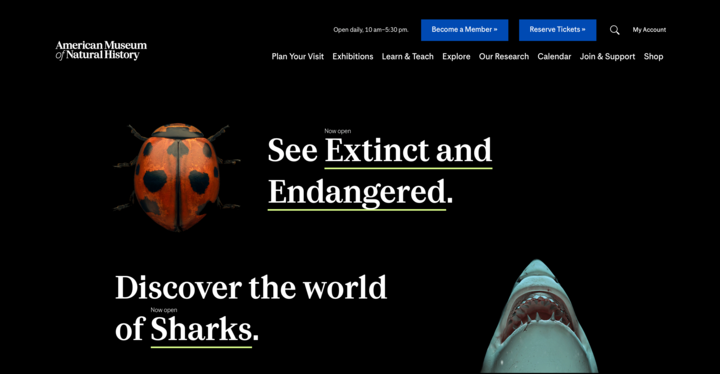
Mugo has worked with the American Museum of Natural History since 2011. We develop and maintain all aspects of the website code, provide support on server management, coordinate features with editorial and science teams, and work on several website properties, including their main website.

Our library client wanted to allow patrons to apply for library cards via their website. The client had existing restrictions on access to cards. Local residents receive free cards while visitors and non-residents pay a fee. Individual patrons should not have access to more than one library card. Therefore the system had to automatically validate and standardize addresses to support duplicate detection, determine a geographical position for each address, and finally classify addresses as local or non-local. We supported this using GeoJSON and integrating with the library's ILS. We tested this functionality a number of ways, including an exploration into the mathematic principles behind the solution.

When creating content in Ibexa using the RichText Editor, it is easy to realize that not every RichText field needs the same toolbar. A ”Body” field may need headings, embeds, and tables. A ”Short Description” or ”Caption” field usually needs bold, italic, and little else. When every field gets the full CKEditor toolbar, it might make editors waste time or even make them think they can add markup your templates were never built for.
Legacy eZ Publish solved this. Ibexa DXP does not, at least out of the box. In this blog post we describe how we added this feature to Ibexa 4.

Welcome to Mugo Web's new monthly digest, a quick way to catch up with some of the things we've been working on. In July we marked a momentous anniversary, launched a brand new site for a client, and offered free educational opportunities.

A new update to the Mugo Page Bundle now allows for a straightforward migration from eZ Flow to Ibexa DXP. We’ve also added functionality to this versatile tool with a new rich text block type.
Mugo partner since 2025
St. Thomas Public Library launches new website with expanded features.

The latest improvements to the Mugo Library platform focus on enhanced usability for library staff. Since these back-end improvements aren’t as noticeable as the front-end user experience, we wanted to take the opportunity to give a peek “under the hood”, and showcase what makes the Mugo Library event and calendar solution ideal for public libraries. Our new enhancements include expanded reporting, a new viewing interface, back-end patron search, and integration with the meeting room module.

One of our clients needed to migrate all their customers to another entitlement service, requiring them to create new Single Sign-On (SSO) accounts. Concerned that many customers might struggle with the SSO setup process and overwhelm the customer support team, Mugo designed a "graduated authentication" system that dynamically balanced temporary free access with required account creation, allowing our client to manage customer support workload in real time. Instead of forcing all customers to the SSO setup at once, a smooth transition was implemented, providing immediate support for anyone who needed it.

Responsive images are a cornerstone of modern web design. They enable websites to deliver optimized visuals that adapt seamlessly to a wide range of devices, screen sizes, and resolutions. By serving appropriately sized images based on the user’s device capabilities, responsive images ensure fast load times, reduced bandwidth usage, and a consistent visual experience.
Mugo Web
Unit 205, 332 Columbia Street
New Westminster, BC
V3L 1A6, Canada
Phone: 604-637-6396
E-mail: hi@mugo.ca